If you have ever handed a toddler a wooden spoon and a upside-down metal pot, you already know an undeniable truth: children are natural-born musicians. Long before a child learns to speak in full sentences, read words, or solve basic math problems, they respond to rhythm, tone, and melody.
In recent years, modern parenting trends have often tilted toward silent digital screens, plastic gadgets with flashy lights, or strictly academic flashcards. However, early childhood development experts and neuroscientists continue to champion a timeless, essential tool: musical toys.
From simple wooden rattles and maracas to xylophones, toy keyboards, and miniature drums, musical toys play a fundamental role in shaping a child’s mind, body, and emotions. Here is a comprehensive look at why musical toys deserve a prime spot in every child’s early playroom.
1. Boosting Brain Development and Language Skills
The human brain grows at an astonishing rate during the first five years of life. Musical play acts as a full-body workout for a developing brain, stimulating multiple areas simultaneously.
When a toddler shakes a maraca or taps out a pattern on a drum, their brain connects auditory feedback with motor actions. This multi-sensory engagement builds neural pathways that directly support language acquisition.
-
Phonological Awareness: Music and speech share critical structural elements—rhythm, pitch, inflection, and cadence. Children who play with musical instruments learn to distinguish subtle differences in pitch and sound timing. This skill directly translates to recognizing phonics and speech sounds later when learning to read.
-
Memory and Processing Speed: Remembering a simple melody or rhythmic sequence trains short-term memory and cognitive recall, laying the groundwork for complex problem-solving.
2. Refining Fine and Gross Motor Skills
Playing a musical instrument is physical work for little hands and bodies. Depending on the type of toy, musical play targets both fine and gross motor development:
-
Gross Motor Skills: Larger musical toys like floor drums, standing keyboards, or marching band kits encourage kids to jump, beat, bend, and move their whole bodies to the beat.
-
Fine Motor Skills: Smaller instruments like kalimbas, mini xylophones, flutes, and toy piano keys require delicate finger movements, hand control, and precision.
-
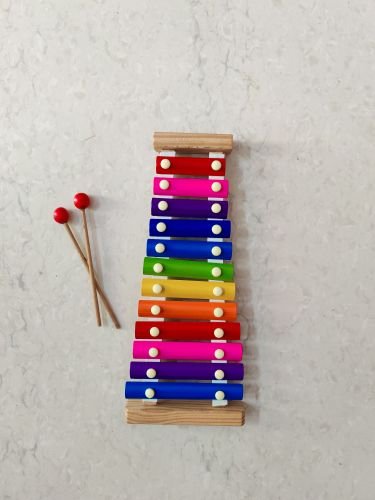
Hand-Eye Coordination: Striking a xylophone key with a small mallet requires visual accuracy and muscle control. Over time, this improves the dexterity needed for writing, using scissors, and tying shoes.
3. Nurturing Emotional Regulation and Self-Expression
Expressing big emotions can be overwhelming for young children who lack the vocabulary to explain how they feel. Music provides a natural, healthy outlet for emotional release.
When a toddler is feeling energetic or frustrated, banging on a drum allows them to channel that tension safely and constructively. Conversely, gentle musical toys like lullaby night-light projectors, soft musical plushies, or gentle rainsticks help soothe an overstimulated nervous system, aiding in relaxation and self-soothing.
Furthermore, making music gives kids a profound sense of agency. When a child realizes that their action creates a pleasing sound, it boosts their confidence, self-esteem, and independent play skills.
4. Building Social Skills and Spatial Awareness
Music is inherently communal. When children engage with musical toys alongside parents, siblings, or classmates, they learn key social behaviors without feeling pressured:
-
Turn-Taking and Cooperation: Playing simple duets or taking turns on a drum kit teaches patience and sharing.
-
Listening Skills: Musical play requires active listening—waiting for a cue, matching a tempo, or stopping when the music stops (like in musical statues).
-
Patterning and Math Readiness: Music is built entirely on mathematical concepts—beats, counting, rhythms, and patterns. Experiencing steady beats through toy instruments prepares children intuitively for early math concepts like fractions, grouping, and sequencing.
5. Screen-Free Active Engagement
In an age where digital screens are increasingly competing for early childhood attention, musical toys offer a tactile, hands-on alternative. Unlike passive screen consumption where a child merely watches a broadcast, musical instruments require active participation. The child is the creator of the experience, not just a spectator.
How to Choose the Right Musical Toys by Age
To get the most out of musical play without overwhelming your child (or your sanity!), pick age-appropriate instruments that match their developmental stage:
| Age Group | Recommended Musical Toys | Focus Area |
| 0 to 12 Months | Wrist rattles, soft musical shakers, sensory rainmaker tubes | Auditory tracking, cause-and-effect |
| 1 to 2 Years | Tap-a-tune xylophones, floor drums, maracas, musical push-walkers | Fine motor dexterity, cause-and-effect |
| 3 to 5 Years | Toy keyboards, ukuleles, triangle bells, rhythm stick sets | Patterning, creativity, coordination |
| 5 Years & Up | Beginner recorders, electronic drum pads, karaoke microphones | Complex rhythm, pitch matching, self-confidence |
Tips for Parents: Embracing the “Noise”
It is completely normal for parents to worry about noisy playrooms. However, “noise” made by a child discovering sound is actually developmental progress in action.
To keep the peace at home while still supporting your child’s musical journey:
-
Set aside dedicated music times during the day rather than leaving noise-making toys out at bedtime.
-
Choose high-quality wooden or acoustic instruments over overly loud, tinny electronic toys with pre-recorded, repetitive loops. Natural sound makers like wooden xylophones or maracas offer richer acoustics and are far easier on parental ears!
-
Join in the fun. Sing along, clap to the beat, or create a family band. Your participation shows them that creative expression is valuable.
Conclusion
Musical toys are far more than mere playthings that keep kids busy—they are foundational developmental tools. By stimulating brain growth, honing physical coordination, supporting emotional health, and teaching social interaction, musical toys give young children a rich start in life.